Go Classic
Play Go online free against the computer on 9×9, 13×13 or 19×19, with captures, ko and area scoring. CPU from easy to hard, 2-player mode, no download.
Go Classic
Play Go online free against the computer on 9×9, 13×13 or 19×19, with captures, ko and area scoring. CPU from easy to hard, 2-player mode, no download.
Quick start
Go Classic
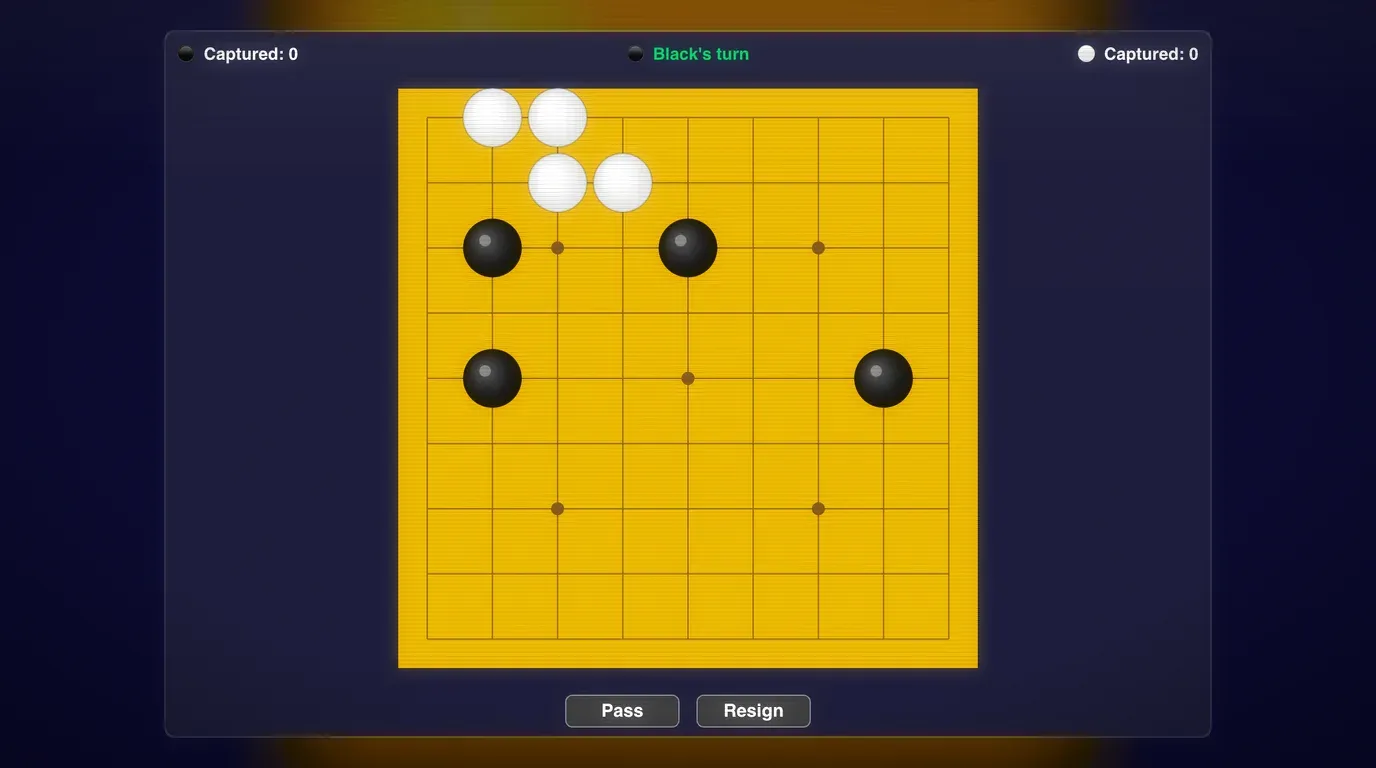
Tap an intersection to place a stone. Surround opposing stones to capture them, and keep your own groups breathing. Two passes end the game: mark dead stones, then accept the score.
More Games
See all games


How to Play
Tap an intersection to place a stone. Surround opposing stones to capture them, and keep your own groups breathing. Two passes end the game: mark dead stones, then accept the score.
How to play Go, step by step
- Black moves first. Players alternate, placing one stone on an empty intersection.
- Touching stones of one colour form a group. A group with no empty neighbour (a liberty) is captured.
- You may not place a stone that has no liberties, unless it captures first.
- Ko: no move may repeat an earlier whole-board position, so a one-stone retake waits until you play elsewhere.
- Two passes in a row end the game. Mark dead stones, check the count, then accept it.
How the score is counted
- Area scoring: your stones on the board plus the empty points that only your stones surround.
- White adds 6.5 komi to balance the first move. The half point prevents a tie.
- Dead stones are removed before the count. After two passes, tap a stone group to mark it dead.
Tips for beginners
- Count the liberties before you place a stone next to an enemy group.
- On 9×9, take the centre early, then claim the corners and sides.
- A group with two separate eyes (empty points inside it) cannot be captured. Keep room for two eyes.
- Pass only when the board is settled. Passing too early hands the opponent the last word.
A short history
Go began in ancient China more than 2,500 years ago. Scholars once ranked it among the four arts a gentleman should master.
It reached Japan and Korea over the following centuries. Japanese schools shaped the modern tournament game, and Korean and Chinese players later led professional play.
Today it is played worldwide. The 19×19 board is the standard, while 9×9 and 13×13 suit quick games and learning.
Glossary
- Atari
- A group with exactly one liberty. Its owner must extend it, or it is captured on the next move.
- Ko
- A repeating capture pattern. The superko rule stops the immediate retake.
- Seki
- Mutual life: two groups share their last liberties, so neither can capture the other safely.
- Komi
- Points given to White to offset Black's first move. Here it is 6.5.
- Eye
- An empty point inside one group. Two separate eyes keep a group alive.
More board games on GamingLab
Go rewards planning like these games. Try them next:
Frequently Asked Questions
Where can I play Go online free against the computer?
Right here on GamingLab. Pick 9×9, 13×13 or 19×19, choose easy, medium or hard, and start. Nothing to install and no account. You can also play a second person on the same device.
What are the basic rules of Go?
Black and White take turns placing one stone on an empty intersection. A group with no empty neighbouring points (liberties) is captured. You cannot play a stone that leaves its own group without liberties, unless the same move captures first.
How is the winner decided?
The game uses Chinese area scoring: your stones on the board plus the empty points that only your stones surround. White adds 6.5 komi to offset Black's first move. After two passes, mark dead stones and accept the score.
What is the ko rule?
Ko stops an immediate recapture that would repeat the position. This version uses situational superko: no move may recreate an earlier whole-board position. You must play elsewhere first, and the game tells you when a retake is blocked.
What does suicide mean in Go?
Placing a stone that leaves its own group with no liberties is not allowed, unless the same move captures at least one opposing group. The tutorial covers liberties and captures in three short steps.
How strong is the CPU?
Easy plays random legal moves and prefers captures. Medium and hard run a tree search guided by Go heuristics (captures, ataris, avoiding self-atari, local replies) for about 0.25 and 0.4 seconds per move in a Web Worker, so the board never freezes. It plays sensibly on 9×9 and 13×13. On 19×19 it is a practice opponent.
Can I play 19×19 on a phone?
Yes. The board uses the full phone width. When you touch the board, a bubble shows the exact intersection above your finger. Lift your finger to place the stone.
What is komi, and why does White get 6.5 points?
Komi compensates the player who moves second. Black moves first, so White receives 6.5 points at the end. The half point means a game cannot end in a tie.
Is there undo or a hint?
Yes. Undo takes back your last move, and in CPU mode also the CPU reply. Hint asks the CPU for a suggested point and marks it with a ring. Both aids are optional.